Close×
November 11, 2026

English Outside the Box: Talking Beyond the Classroom

With Entente Canada-Québec (ECQ) funding, we (Jean-Michel Dôme, Stephanie Lapointe, and Olivia Tessier) developed English Outside the Box, a project at Cégep de Jonquière that gives students low-stakes, collaborative opportunities to communicate spontaneously in English beyond the classroom. 

Through workshops, outings, and conferences, our goal was to foster students’ willingness to communicate.  

Thinking outside the classroom  

Speaking is often one of the biggest challenges for students learning a second language, especially when they have few opportunities to practise outside the classroom. At Cégep de Jonquière, in the Saguenay-Lac-Saint-Jean region, access to English in everyday life is quite limited. 

We wanted to make English more accessible and give students more opportunities to use the language in authentic situations. Our tutors at the HELP Centre already organize a few workshops, but we wanted to increase students’ exposure to English, so we applied for an ECQ grant for our project, English Outside the Box. With this funding, we were able to expand our initiatives and develop 3 main modules:  

  • interactive workshops organized by student tutors 
  • outings and activities in the community 
  • guest speakers and conferences 

We wanted to foster students’ willingness to communicate in English by providing engaging, collaborative, and relatively low-pressure environments. 

The goal was not just to organize activities: it was to create a culture in which students could use English beyond the classroom while also building connections within the CEGEP and the Saguenay community. 

Task-based approach 

One pedagogical idea behind English Outside the Box was the task-based approach. Rather than organizing language learning primarily around grammar, this approach gives students meaningful tasks to accomplish through communication. It offers a more interactive, engaging way of learning by putting students at the centre of the action. Instead of simply practising English, students use it to achieve a concrete goal. For example, students might: 

  • take and remember orders in a simulated restaurant 
  • create and present a piece of artwork 
  • organize a workshop for their peers 
  • participate in a professional meeting 

Students learn to use English by interacting with others, solving problems, taking initiative, and achieving something together. 

Surveying students’ interests 

At the beginning of the semester (Fall 2025), we surveyed students to identify their interests and preferences. The results helped us develop the various activities. 

The most popular choices were: 

  • cooking (254 votes) 
  • escape rooms (245 votes) 
  • Kahoot (225 votes) 
  • board games (198 votes) 
  • murder mysteries (157 votes) 
  • movie-and-music-related activities (144 votes) 
  • arts and crafts (140 votes) 
  • trivia (134 votes) 

We were surprised to discover that cooking was the most popular! 

The workshops 

At Cégep de Jonquière, the HELP Centre trains about 10 tutors each semester as part of a credited English course. In the context of this course, tutors must organize an activity that encourages students to speak English in a fun, interactive way. This provided a natural opportunity to involve the tutors in English Outside the Box. 

We shared the survey results with the tutors and challenged them to develop 50-minute workshops that would appeal to their peers. Working in pairs, they brainstormed ideas and presented their proposals to other teams for feedback. The variety and originality of their ideas was certainly impressive! 

As project leaders, our role was to guide the process without taking over. Our responsibilities included: 

  • guiding tutors in selecting and developing workshop ideas 
  • training tutors to facilitate activities effectively 
  • creating a calendar to ensure a balanced distribution of activities 
  • promoting workshops across the college 
  • surveying participants to gather feedback and assess their experience 

The guiding principle was simple: workshops designed by students for students. We gave tutors creative ownership while providing structure and support to keep the project on track.  

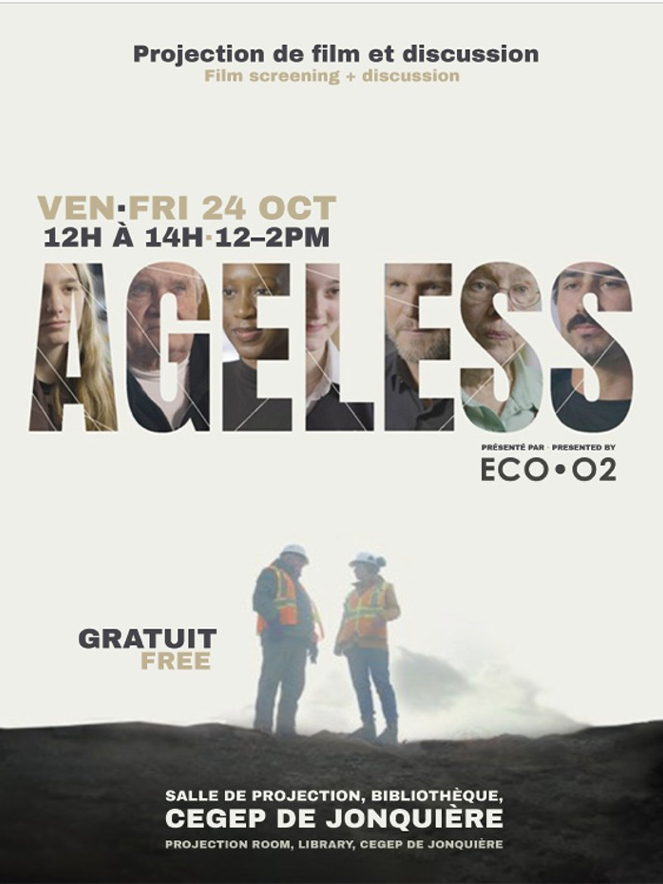
The tutors created 9 workshops. Most took place at lunchtime, and we scheduled them on different days to accommodate the tutors’ availabilities. We also organized an additional workshop called Ageless, hosted by ECO-02, an English Community Organization in Saguenay-Lac-Saint-Jean, featuring a film screening followed by a discussion. In total, there were 10 workshops across the fall and winter semesters. 

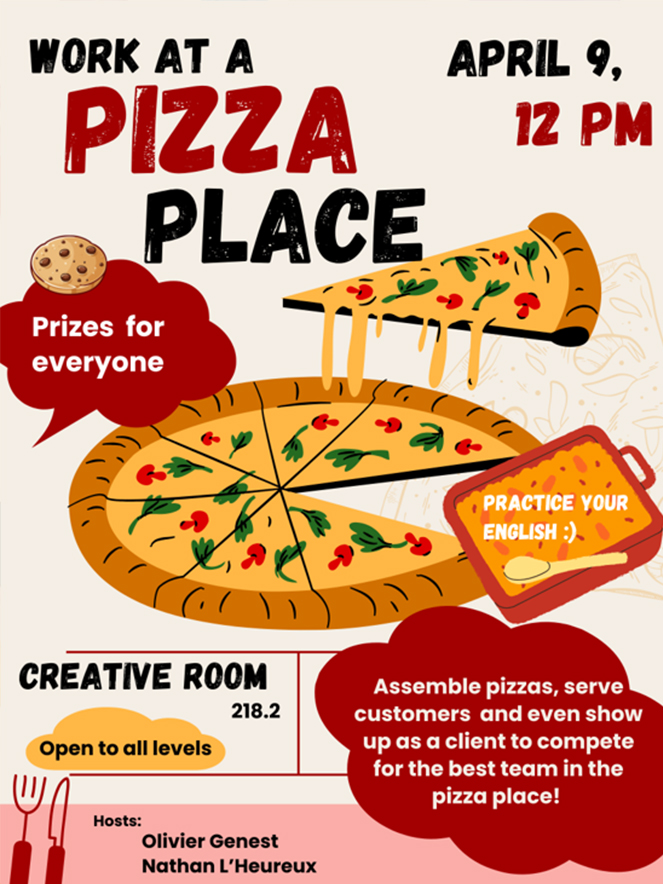
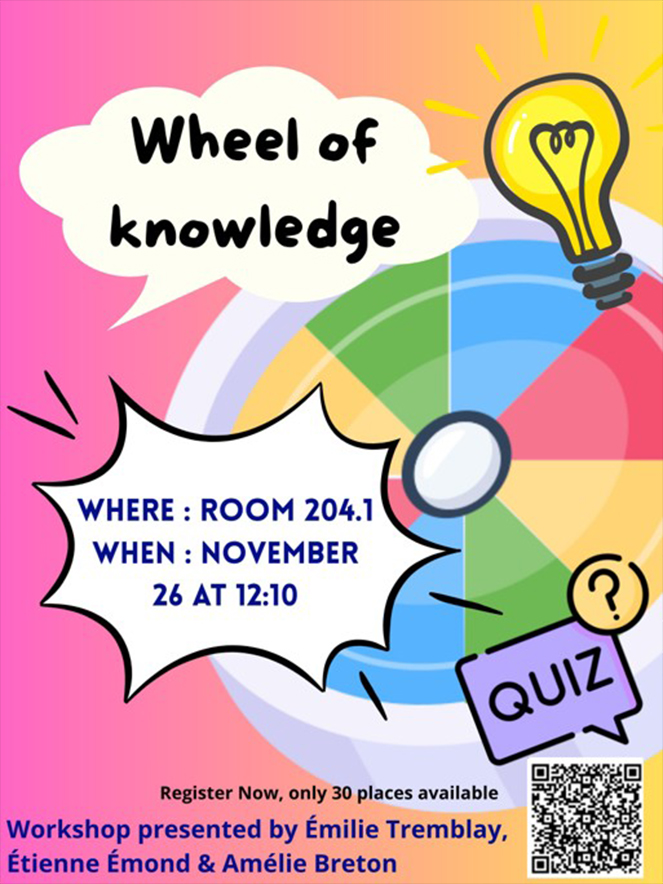
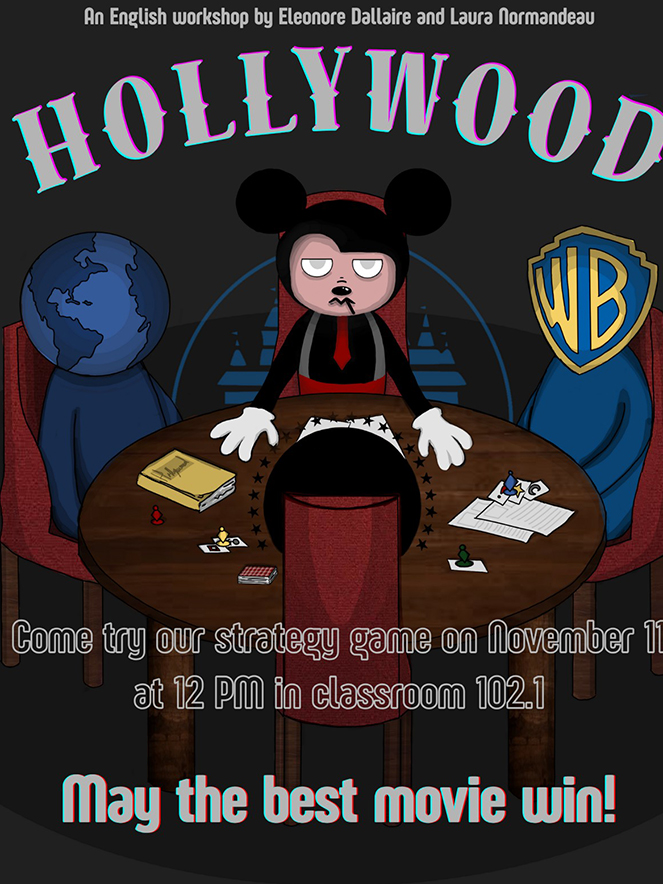
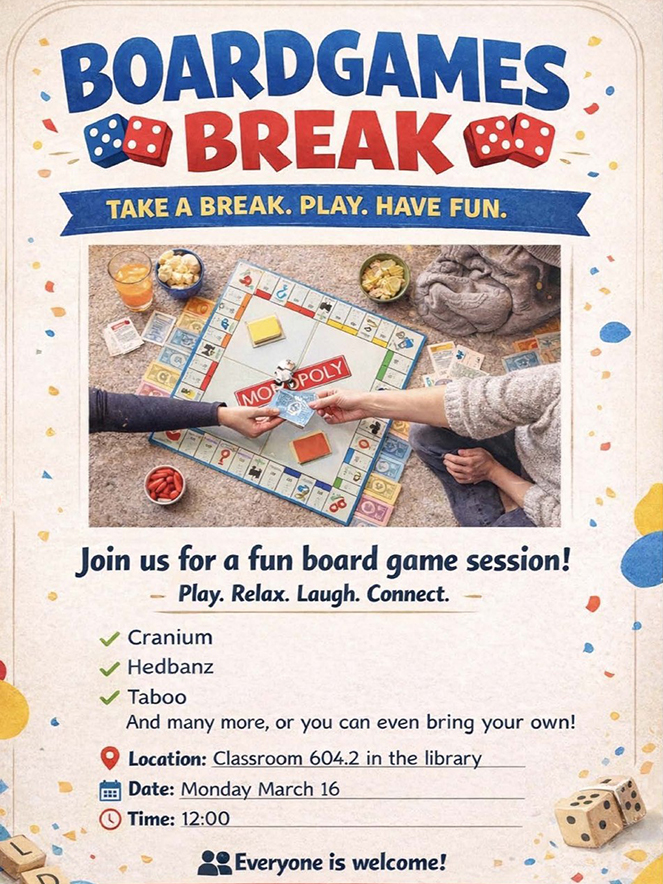
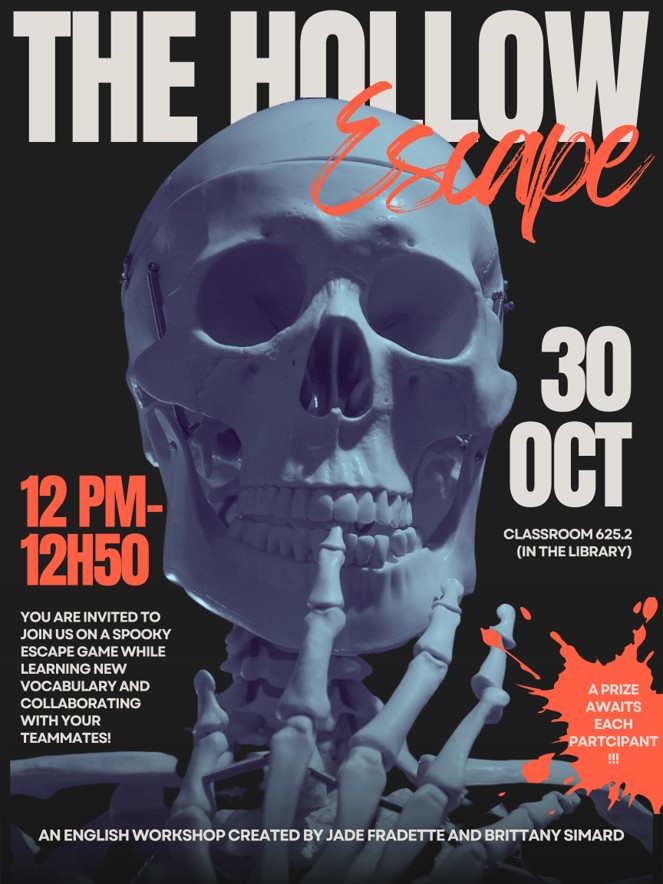
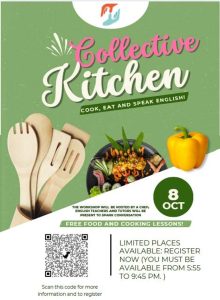
Posters presenting all the workshops offered to the students

The outings  

Beyond the workshops, we organized 3 outings that provided students with opportunities to use English in authentic settings. 

The collective kitchen 

Cooking was the top choice in our initial student survey, so we wanted to offer students the chance to prepare a meal together. We learned that the college had a collective kitchen, so what was originally planned as an outing ended up taking place inside the college. 

We arranged for a session to take place entirely in English. We translated the instructions, and the chef and facilitator agreed to lead the activity in English. Students followed the instructions, prepared meals together, and then enjoyed what they had made. The activity lasted more than 4 hours and attracted over 100 participants that day!

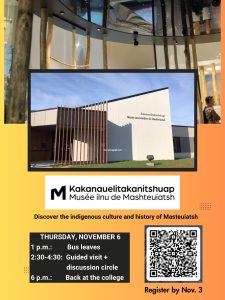
A visit to Mashteuiatsh 

In the fall,15 students travelled by bus to Mashteuiatsh, an Indigenous community in the Saguenay-Lac-Saint-Jean region. After a visit of the museum conducted in English, students watched a video exploring stereotypes experienced by First Nations people and took part in a discussion about prejudice, stereotypes, and ways to overcome them. 


Visiting the Bagotville military base 

In the winter, students visited the Canadian Armed Forces base in Bagotville, about 30 minutes away from the college. A commander introduced them to the work involved in intelligence meetings, including a simulation based on real, unclassified information. Students also met military personnel who explained their roles, what life on the base is like, and how English is used in a predominantly French-speaking region. 

Conferences  

The conferences were the most difficult activities to organize. We needed to find guest speakers who had a message that would appeal to students and who were available.  

The speakers came from a range of professional backgrounds, giving students opportunities to discover new fields, hear personal stories, and ask questions in English:  

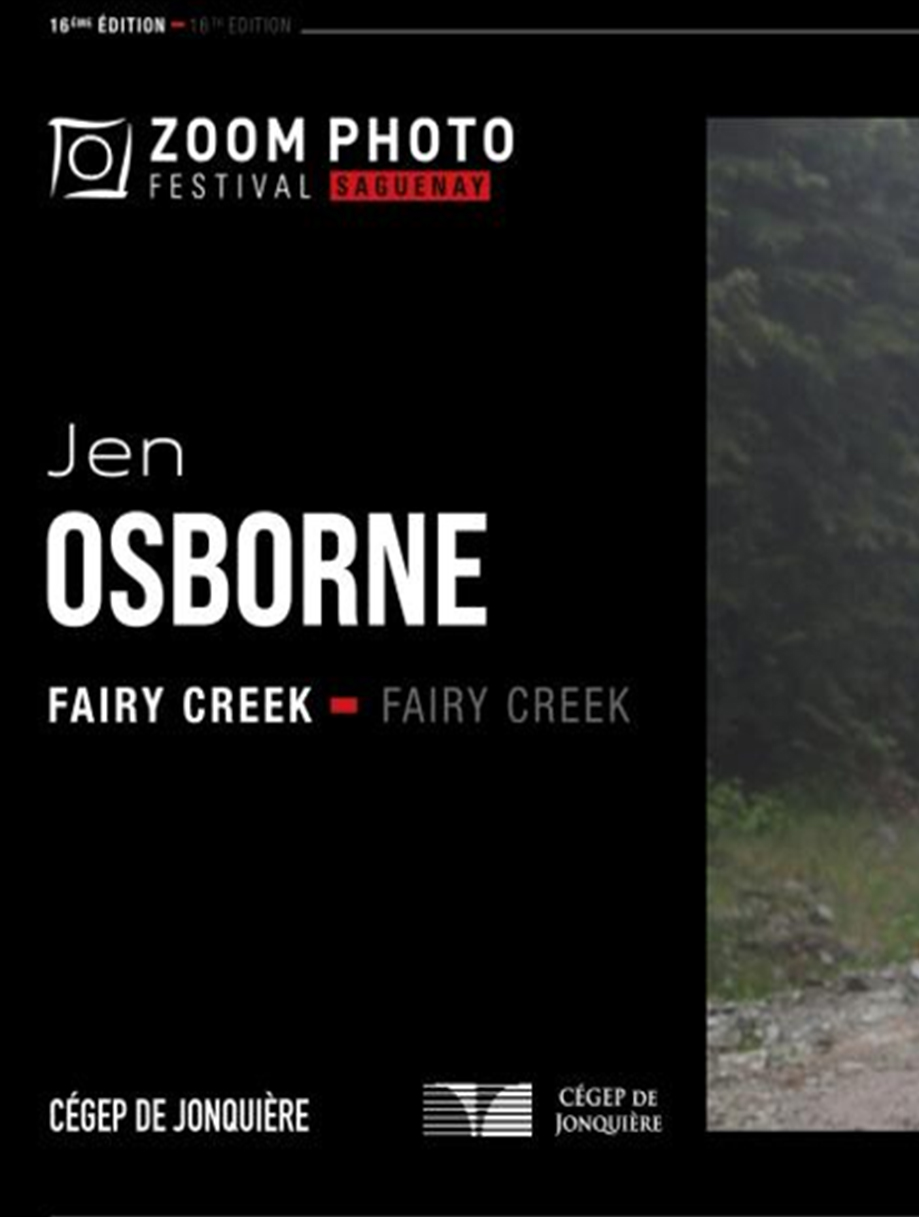
  • Jen Osborne, activist and photographer: Students explored her photography exhibition, attended a presentation, and had the opportunity to ask questions. 
  • Claudia Tessier, entrepreneur: She shared her educational and professional journey, encouraging students not to worry about having their career paths figured out. 
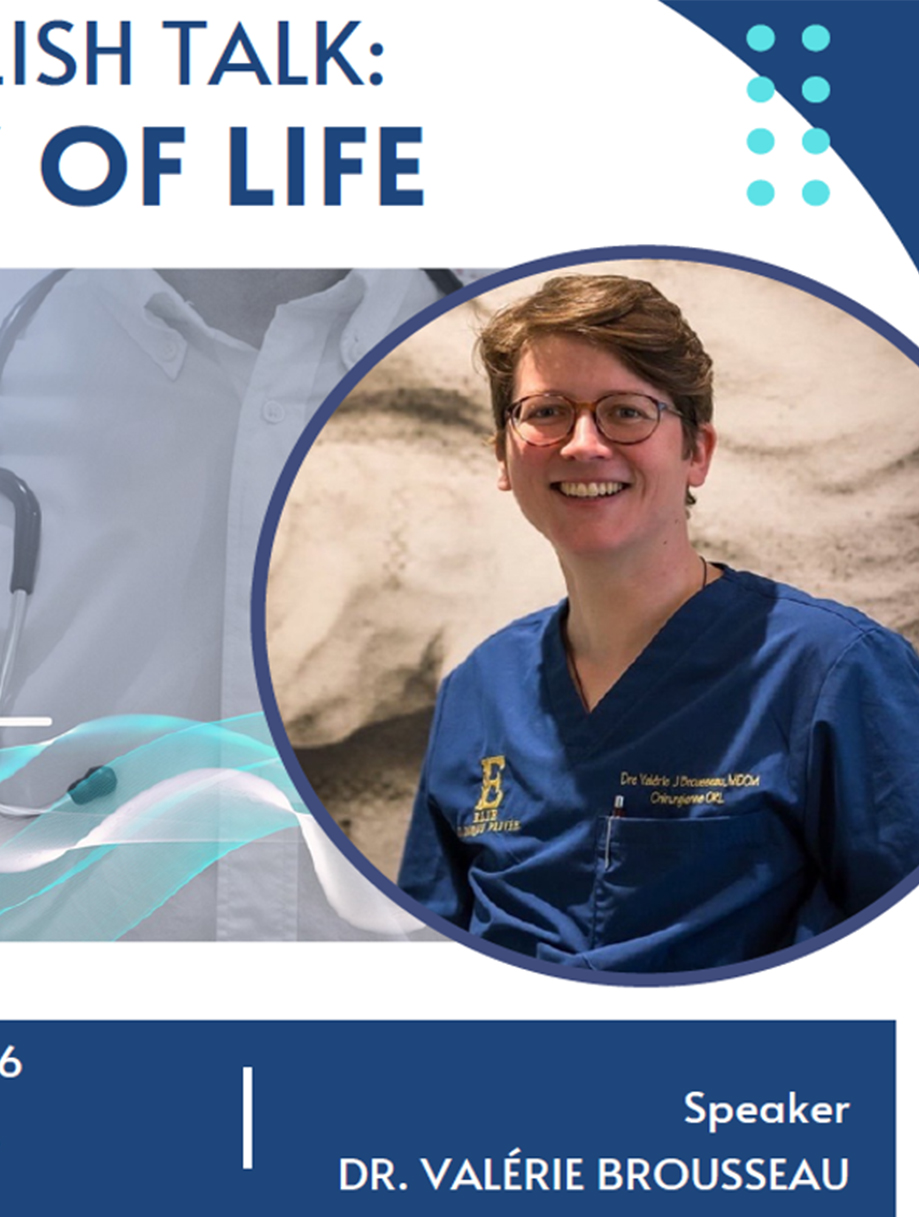
  • Dr. Valérie Brousseau, ear, nose, and throat specialist, and a social media influencer: She discussed her professional journey and how studying in English and taking a public-speaking course helped build her confidence. 
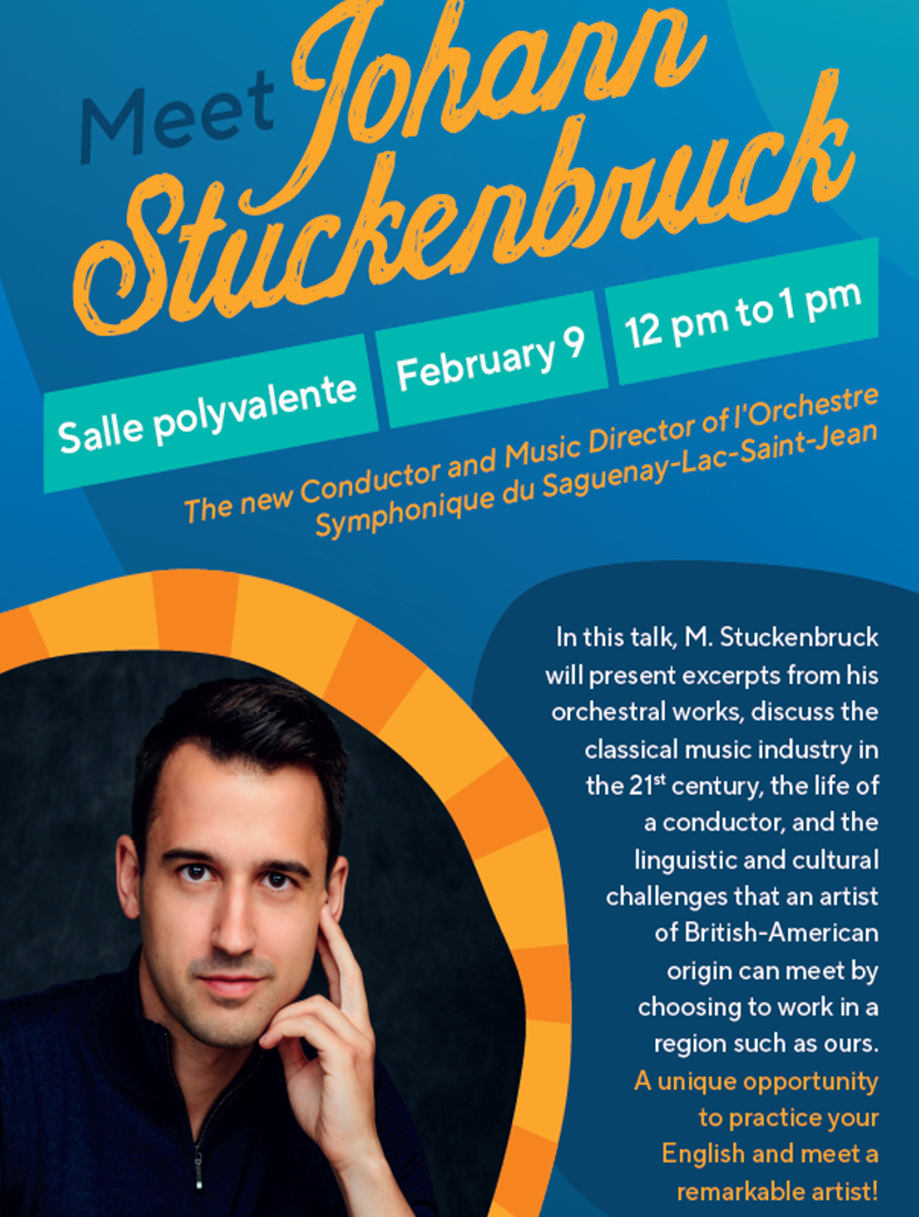
  • Johann Stuckenbruck, conductor of the Saguenay Symphony Orchestra: He participated in a student-led interview during the Semaine de la formation générale and answered students’ questions during a class visit. 
  • Keven St-Gelais, creative writer: He led an interactive workshop on writing short horror films and sketches (offered twice). 

Posters presenting the 5 conferences

Outcomes and student feedback 

Participation  

Getting students to participate required some promotion. We advertised the workshops and activities in classrooms and put up posters around the college.  

Teachers also experimented with different ways to encourage participation. Some offered bonus points, some awarded up to 5% for participation, while others adapted their course plans to let students attend activities to replace in-class speaking assignments. The latter proved most effective, and students appreciated the flexibility! 

Incentives helped attract participants, but they weren’t the whole story. We collected feedback through short surveys after each activity. Some students came simply to have fun and practise their English, or because they were interested in the activity itself, rather than solely for course credit. 

Participation was strong throughout the year. We welcomed 184 participants in the fall and 173 in the winter. Students in different ESL course levels (100, 101, 102, and 103) took part. 
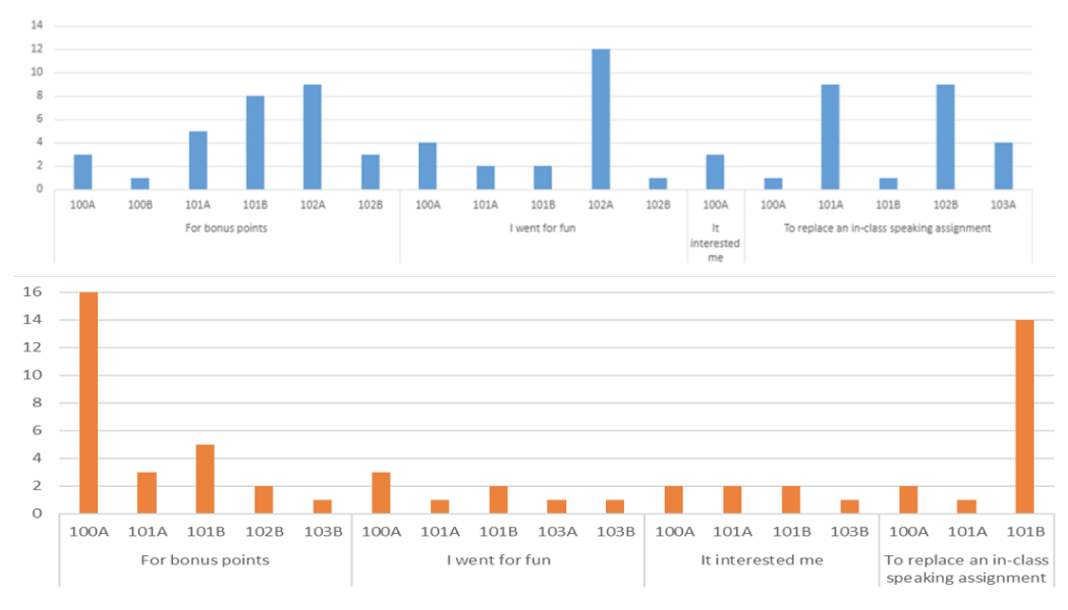
Students’ reasons for participating in activities during the fall and winter semesters

Willingness to communicate  

 One question in our surveys asked students to reflect on whether they: 

  • communicated in English as much as they wanted to 
  • communicated more than they had expected to 
  • wished they had communicated more 

We were particularly interested in the 2nd response, as it indicated students’ willingness to communicate. One of our main goals was to encourage students to speak more English than they normally would, especially in contexts where they might not otherwise use the language. 

The results were encouraging: 41% of students in the fall and 24% in the winter reported speaking more English than expected. We believe this difference may be related to the types of activities offered. The fall semester featured more interactive workshops, particularly the collective kitchen, while the winter included more conferences.  

Overall appreciation  

Students also rated their overall satisfaction with the activities on a 5-star scale. The results were very positive across both semesters: 5 stars was the most common rating, followed by 4 stars. This suggests that students generally enjoyed the activities and valued the opportunities to practise English outside the classroom. 

Teamwork makes it possible 

The project really showed us the importance of teamwork. We each brought different strengths to the table: 

  • Jean-Michel had experience working with tutors, organizing workshops, and promoting activities. 
  • Stephanie brought her experience with ECQ projects, surveys, and reporting. Her journalism background also helped us connect with guest speakers. 
  • Olivia, a newer teacher, contributed fresh ideas, enthusiasm, and creativity while gaining valuable experience along the way. 

A project like this is difficult for one teacher to manage alone. Working as a team allowed us to share responsibilities, support one another, and involve colleagues, student tutors, and community organizations.  

ECQ funding made this collaboration possible. It covered our release time for planning and coordination, transportation for outings, activity-related expenses, and prizes. Just as importantly, it gave us the time and flexibility to build partnerships and coordinate activities. By pooling our strengths and sharing the workload, we could offer students a much wider range of opportunities to use English beyond the classroom. 

A new project for 2026-2027: The Public Speaking Club  

Building on our previous experience, we are launching a new initiative to help students gain confidence speaking English in front of others. This time, we are taking collaboration a step further by bringing together students from different CEGEPs through an intercollegiate public speaking club. 

The pilot project currently involves 3 CEGEPs in the Saguenay-Lac-Saint-Jean region: 

  • Cégep de Jonquière (12 students) 
  • Cégep de Chicoutimi (10 students) 
  • Cégep de Saint-Félicien (7 students) 

Throughout the semester, students will take part in 7 workshops, held approximately twice a month, where they will practise public speaking, spontaneous discussions, and prepared speeches. Club members will also visit regular English classes to lead activities for their peers. 

We are also planning 2 regional galas, one in the fall and another in the winter. These gatherings will bring everyone together for a friendly dinner, spontaneous debates and discussions, and prepared speeches delivered before an audience. Finally, all participants will have the opportunity to go on a 4-day trip to Ottawa to immerse themselves in an English-speaking environment. 
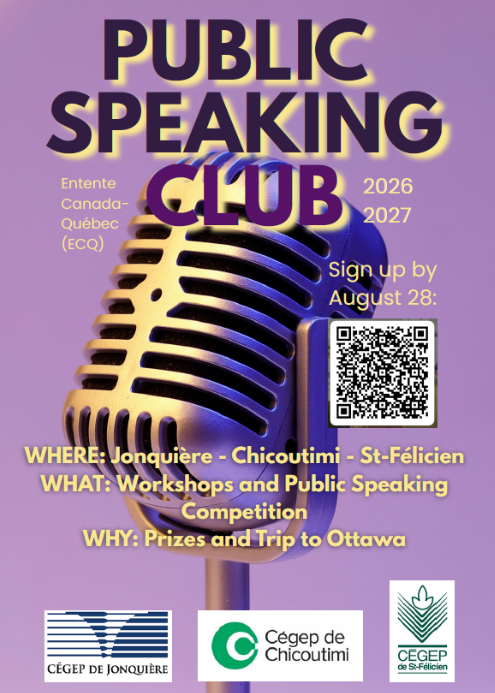
Poster promoting the Public Speaking Club

An invitation to other CEGEPs 

We hope this pilot project is just the beginning! We would love to hear from other CEGEPs interested in joining the initiative. What has started as a regional collaboration could grow into a provincial collaboration across the college network. If you are interested in this project, please reach out. Who knows where this could lead? 

Conclusion 

We hope our experience inspires other teachers to create opportunities for students to use English outside the classroom. Have you tried something similar, or are you thinking about starting a project of your own? Share your ideas or experiences in the comments. We’d love to hear from you!

About the authors

Jean-Michel Dôme

Throughout his 30 years of experience teaching English at Cégep de Jonquière, Jean-Michel Dôme has been deeply committed to collaboration, professional learning, and community building. These values have guided his involvement in numerous institutional initiatives and leadership roles. In addition to ECQ-funded projects, he helped create a local program designed to support and welcome new teachers (PARÉ). He has also served as coordinator of the Department of Modern Languages, the HELP Centre, and the General Education Committee.

Stephanie Lapointe

Stephanie Lapointe, BA, BEd, MA and ESL teacher since 2010, is always seeking out new initiatives to make learning hands-on and enjoyable. Having participated in several ECQ projects ranging from offering workshops for in-service teachers, to creating field-specific 360° videos with accompanying pedagogical material, to organizing opportunities for students to engage in authentic communicative situations, Stephanie believes that the success of these projects stems from getting other teachers involved in working towards a common goal.

Olivia Tessier

Olivia Tessier has been teaching ESL since 2015 in private schools to adult students, both in Québec City and in the Saguenay-Lac-Saint-Jean region. Since 2023, she has been teaching ESL at Cégep de Jonquière. She has recently completed a master’s in education with a focus on the gamification of English grammar to help students verbally express themselves in their target language. She is creative and likes challenges, which ultimately led her to participate in the ECQ project English Outside the Box.

Subscribe
Notify of
guest

0 Commentaires
Inline Feedbacks
View all comments