

In June 2024, I attended the keynote session of the SALTISE conference online. This presentation given by Mutlu Cukurova, professor of Learning and Artificial Intelligence at University College London, was titled Interplay of Learning, Analytics, and Artificial Intelligence in Education. (The keynote speaker had published an article with the same title a few months before.)
I present here a summary of some of the ideas expressed during the presentation.
Using AI to produce pedagogical content?
Mutlu Cukurova’s lab compared the potential of AI-generated educational videos, created from a script written by humans, to that of similar videos recorded by real teachers.
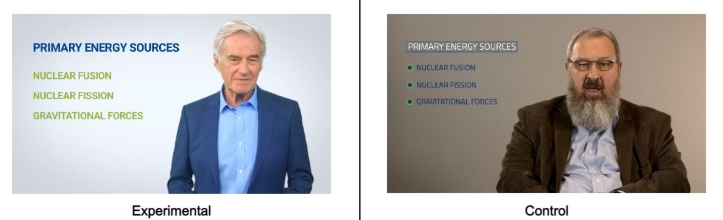
Images from 2 videos. The one on the left was AI-generated, while the one on the right was recorded by a real person (Source [PDF])
This observation might make one consider the potential of AI-generated videos for hybrid teaching, for example!
However, later in the presentation, Mutlu Cukurova offered some nuances by citing studies showing that people trust content presented as coming from AI less than the content presented as coming from scientific research.
The distinction seems clear, in the public perceptions, between using AI to mediate content and using AI to generate ideas. That said, during his presentation, Mutlu Cukurova presented several examples of situations where interacting with a conversational robot (and not just reading a text) seems to have interesting pedagogical potential. (He notably presented an excerpt from this video showing an AI guiding a student in solving a math problem.)
AI as a tutor and learning aid
According to the presenter, research currently indicates that, as a tutor, AI performs better than a human who is not a trained tutor in the targeted teaching discipline but performs less than an expert human tutor.
When considering AI as a tutor, we might be worried that learners will focus more on acquiring declarative knowledge rather than developing soft skills and interacting with their peers. However, Mutlu Cukurova gave the example of a private American primary school where students spend 2 hours every day interacting individually with AI. The rest of the day is spent interacting with adults and in groups, developing transversal competencies and methodological skills. A young student interviewed in the news report which Mutlu Cukurova presented an excerpt of during his presentation, praised the quality of the feedback provided by AI. The cofounder of the school highlighted the potential of differentiated instruction offered by this approach.
In addition, during the presentation, Mutlu Cukurova mentioned Khanmigo (developed by Khan Academy), noting that it is not available in Canada. I looked into this tool, which I was unfamiliar with (thinking it would eventually come to Canada). It is difficult to judge without trying it out. Still, I’m convinced it will pique the interest of teachers (especially since the version intended for teachers is currently free) and students.
On a different note, Mutlu Cukurova explained that his lab used AI to evaluate student engagement with online pedagogical content by measuring their heart rate, pressure on their seat (to determine if the person is leaning forward or slumping), and facial expression. The system provides suggestions to students:
- take breaks
- adjust the pace of the content
- etc.
Another (bold?) way to use AI to support learning!
Not to revolutionize learning but to enhance experiences
According to Mutlu Cukurova, AI will not revolutionize teaching on its own. But he invites practitioners (and researchers) to steer change in the right direction from a human-centered perspective.
In fact, according to the researcher, not all aspects of teaching and learning can be modelled by AI. He argues that some aspects of teaching come from slowly experiencing the learning process.
Mutlu Cukurova explained that his lab has tools to analyze the students’ learning experiences when working in teams to solve problems. It analyzes speaking time, facial expressions, gaze direction, etc. Instead of creating an AI model that would use this data to make suggestions to learners to optimize their learning, the data is shared with the learners simply to enhance the learning experience they just had and “make it visible.” According to Mutlu Cukurova, this is appreciated by the participants, who claim it helps them become aware of their own experiences and those of their peers.
Always the idea of enhancing the process rather than the product
There is no point in having the students use AI to produce work that another AI would then grade to assist the teacher. This would lead to dystopian educational institutions where no one would truly learn and no one would truly teach. In other words, AI should not be used to automate poor practices in teaching and learning.
For Mutlu Cukurova, in teaching and learning, the value of using AI generally lies in the interaction with AI (which can act as a tutor, for example). The product itself is less important. Therefore, the expected productivity gain from AI doesn’t lie in what is produced in the end but in the interaction process that led to it.
The keynote speaker explained that when students are assigned a long paper or an essay, the expectation is not that their work will revolutionize knowledge and be worthy of publication in a scientific journal. Instead, the goal is for the writing process to help them learn how to research information, analyze it, etc. It is, therefore, the process that should be evaluated, not the final product.
Mutlu Cukurova conducted a research project in which his students had to write an essay on Google Docs. He requires access to their file history to analyze their writing process (total active writing time, delay between starting and finishing the essay, types of editing made to the document, etc.). Results show that providing feedback based on these analytics had little impact on students who were already performing well but significantly helped weaker students with fewer metacognitive skills.
This reminded me of the practices of Jules Massé, who was a philosophy teacher in 2015 [in French]. It was well before AI became widely accessible. Jules Massé didn’t analyze students’ work methods retroactively but guided them by breaking down the task into several steps. His main objective was to prevent plagiarism, but his practices had the “side effect” of familiarizing students with effective work methods. It shows that even though tools evolve, good pedagogical practices remain the same through time!
New competencies to develop; choices to make
To use AI properly, teachers have to hone the necessary competencies. For Mutlu Cukurova, these competencies differ from those associated with using “traditional” information technologies. Similarly, the researcher highlights that teaching students to use AI isn’t just about having them use AI: there are other competencies that need to be developed first.
As the speaker mentioned, the goal should be to use AI to make people more competent rather than more dependent on it. If we get used to delegating all our tasks to AI, we risk losing the ability to perform them ourselves. It is, therefore, crucial to make wise choices about which tasks we delegate to AI.
During the Q&A session at the end of the presentation, Mutlu Cukurova explained that companies developing AI tools have a commercial objective to get as many users to spend as much time as possible on their platforms and to use them as frequently as possible. This goal doesn’t align with our objectives as educators, and Mutlu Cukurova encouraged the participants to “push back” against this trend.
What about you? How do you position yourself regarding the use of AI in teaching and learning?
